Open-plan office
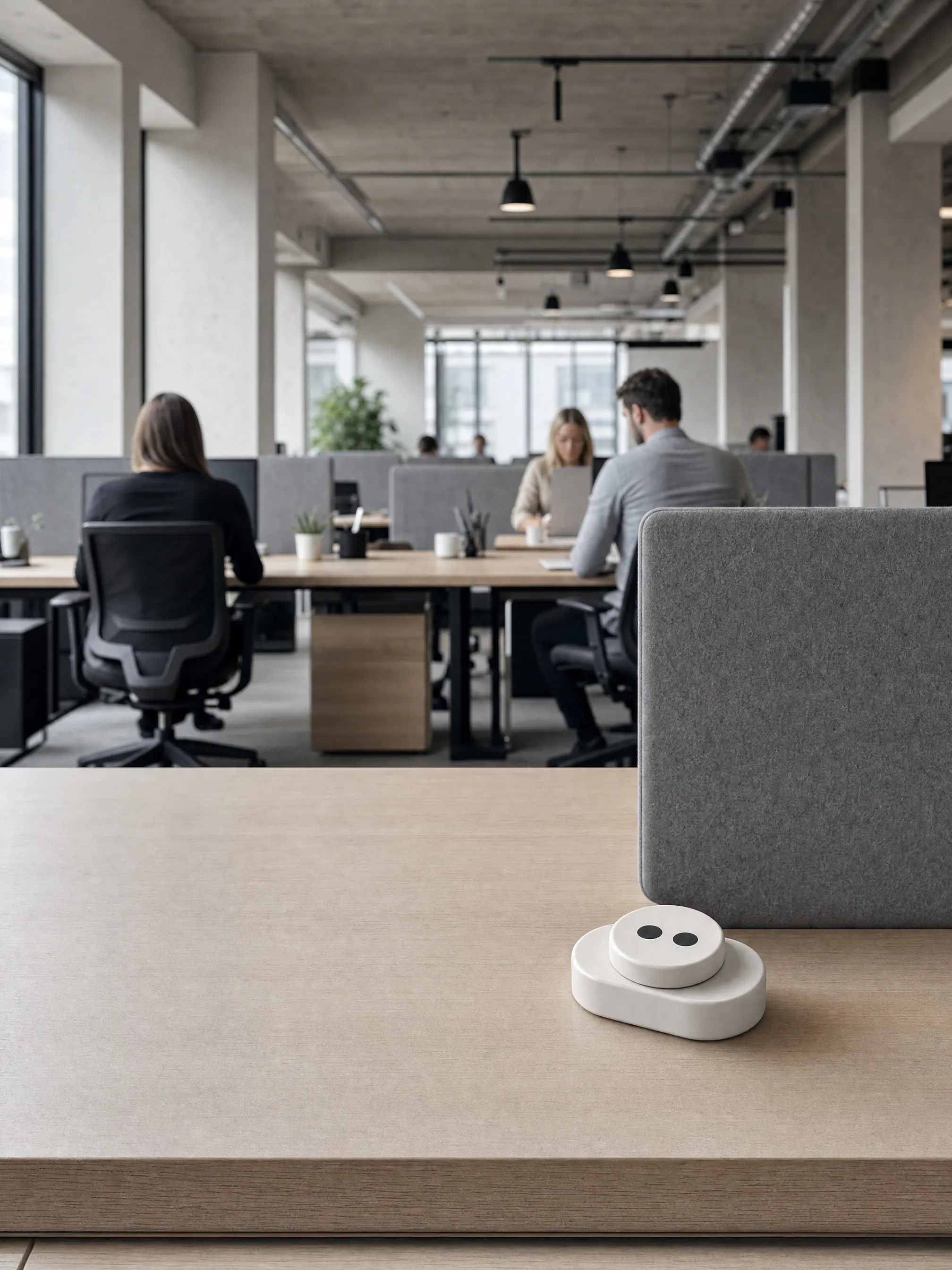
Sound masking in the open-plan office
It is not the volume that breaks your rhythm. It is the words you understand although you never wanted to hear them.

Flyer · Open plan
The Quell flyer to leaf through – and as a print version to download.
The room is quiet. Nobody gets anywhere all the same.
Three desks away, a colleague is on the phone to his insurer. You are halfway through a calculation and two minutes later you know when his car is due for a service. Not because you listened. Because your brain had no choice: the moment speech arrives intelligibly, it gets read along.
That is why open-plan offices do not fail on decibels. A copier in the same room would measure louder and disturb less. Research calls it the irrelevant speech effect, and the measured losses on tasks involving text and numbers run into double-digit percentages.
The usual remedies miss. Headphones cut you off from the team, which was rarely the point of an open office. Acoustic panels shorten the reverb, but they take nothing away from the clarity of a voice two metres away. And a wall is a building project.
From the open-plan floor
Nobody hears the next desk
What changes in the room
Speech loses its edges
Intelligibility lives in the consonants and in the short gaps between them. That is exactly the range Quell covers with an even sound bed. A clear sentence turns into a murmur.
The level stays yours
You set how loud it should be in principle, and how much room the device has around that. When the floor gets busier, it rises gently. When the office empties in the afternoon, it steps back.
Meetings stay in the meeting room
Glass walls look good and hold back very little. A device at the edge of the room, or on the pane itself, means that what reaches the outside is that people are talking, not what about.
No building work, no cables in the floor
Putting it down is the installation. There is nothing to mount on the ceiling and nothing to chase into a wall. When the floor plan changes, the device moves with it.
What this looks like in a real office
One device covers the area in which you would normally hold a conversation without raising your voice. In practice, depending on furniture and ceiling height, that is roughly twenty to thirty square metres. Where shelves and plants break up the space it tends to be more; in a stripped concrete room, less.
We do not start with a spreadsheet, we start with the room. You describe the floor and where it hurts, we tell you how many devices that takes and where they should stand. If two solve the problem, we will not sell you eight.
Common questions
- Does the room not simply get louder?
- Measurably yes, perceptibly no. The level rises by a few decibels and the disturbance falls anyway. That sounds contradictory and it is the heart of the matter: what disturbs is not the level, it is the intelligibility. Most people stop noticing the sound bed after half an hour and only notice it again when you switch it off.
- Does it interfere with calls and video meetings?
- Not for the person on the other end. Modern headsets and conferencing systems strip out steady background sound reliably, because that is what they are built for. Irregular noise is the hard case, and irregular noise is what Quell covers.
- Does this replace acoustic panels?
- No, the two solve different problems. Panels shorten reverberation so a room stops ringing. Masking takes intelligibility out of speech across distance. In a very live room the order is clear: reverb first, masking second.
Let us talk about your room.
Tell us where it is too open. You get an honest read on whether masking solves your problem, and if it does not, we will say so.
Talk to us