How it works
Masking sounds like covering things up. It is the opposite.
Masking drowns out nobody. It fills the short gaps your brain uses to turn sounds into meaning. The result: you still hear that someone is speaking. You just cannot follow it any more.
Explained in two minutes
How sound masking works
The principle
Not louder. Less intelligible.
Sound masking does not drown speech out — it fills the gaps your brain uses to assemble meaning.
Intelligibility lives in the consonants and in the short pauses between them. Lay a gentle, even bed of sound across exactly that range and speech loses its edges. You still hear that someone is speaking. You simply cannot make it out.
That is why a room with Quell does not feel louder — it feels calmer. The measured level goes up; the distraction goes down.
- Speech
- Masking
- What stays intelligible
Simplified illustration of the principle: the masking curve sits where intelligibility is formed.
The form
The surface is the speaker.
No grille, no visible driver, no box that announces itself.
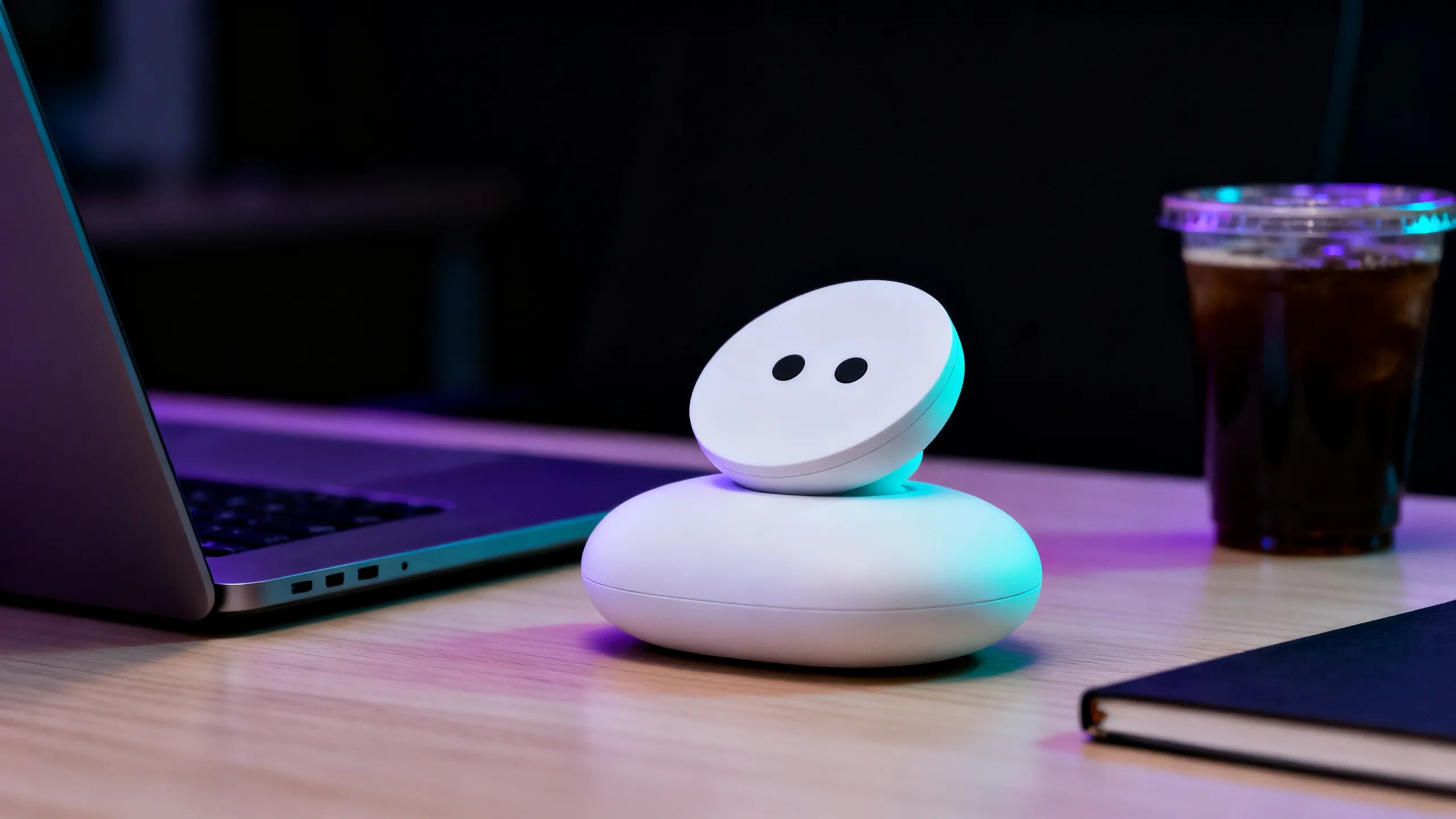
There is no loudspeaker inside. There is a surface transducer. It couples to whatever the device stands on — desk, sideboard, acoustic panel, glass partition — and makes that surface vibrate.
The sound then comes from the whole surface instead of a single point. It spreads evenly, has no locatable source, and there is nothing to mount and nothing to wire.
Invisible
The surface radiates, not the device. Nothing in the ceiling, nothing in the wall.
Even
Diffuse coverage instead of a point source — no “it is louder over here”.
Ready at once
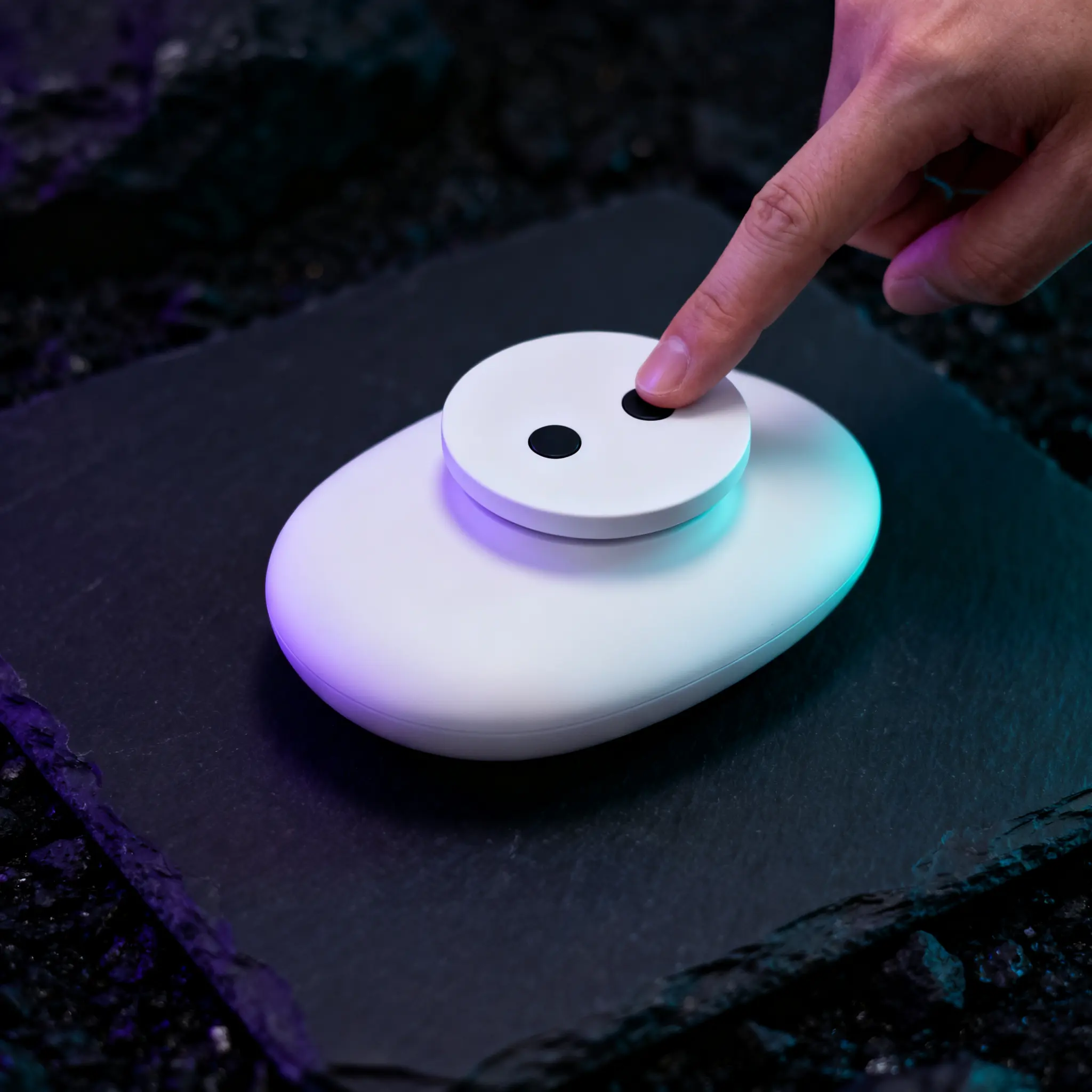
Set it down, switch it on. No electrician, no building work.
The difference
A control loop, not a playlist.
Most masking devices play a file. Quell measures the room continuously and adjusts to it.
Runs entirely on the device. No cloud, no internet needed.
Analyse
Measures the level in the speech frequency range, continuously.
Separate
Tells its own sound apart from the room’s.
Assess
Reads the true ambient level.
Adjust
Moves the volume smoothly — no pumping.
The room changes — and the loop starts again.
When the room gets lively, Quell lifts the masking level gently. When it settles, Quell eases back. You never notice the regulation — you only notice that it stays comfortable.
Your own volume stays the reference point: you set how loud it should generally be, and how much room the device has to move around that.
Engineering
Built in Linz. Built to stay.
Firmware, app and cloud come from one team and are maintained together.
- Sound output
- Surface transducer — the supporting surface radiates
- Adaptive control
- Measures the room continuously and follows it automatically
- Audio processing
- 8-band equaliser, WAV and MP3
- Privacy-Glass
- Analyses the pane and masks through the glass
- On-device controls
- 2 capacitive touch pads — no phone required
- Control
- Bluetooth Low Energy, PIN protected
- Mesh
- Up to 20 devices, authenticated
- Updates
- Signed firmware over app, mesh or network
- File transfer
- USB drive mode for your own sound files
- Engineering
- Firmware, app and cloud from one team
- Origin
- Engineered and manufactured in Linz, Austria
Prototype status: devices are verified on real hardware. Series certification and market approval are in preparation — ask us for the current state.
And if you would rather hear it than read about it?
We put a device in your room for two weeks. Then you decide. No demo appointment, no sales loop.
Let us talk about your room.
Tell us where it is too open. You get an honest read on whether masking solves your problem, and if it does not, we will say so.
Talk to us